

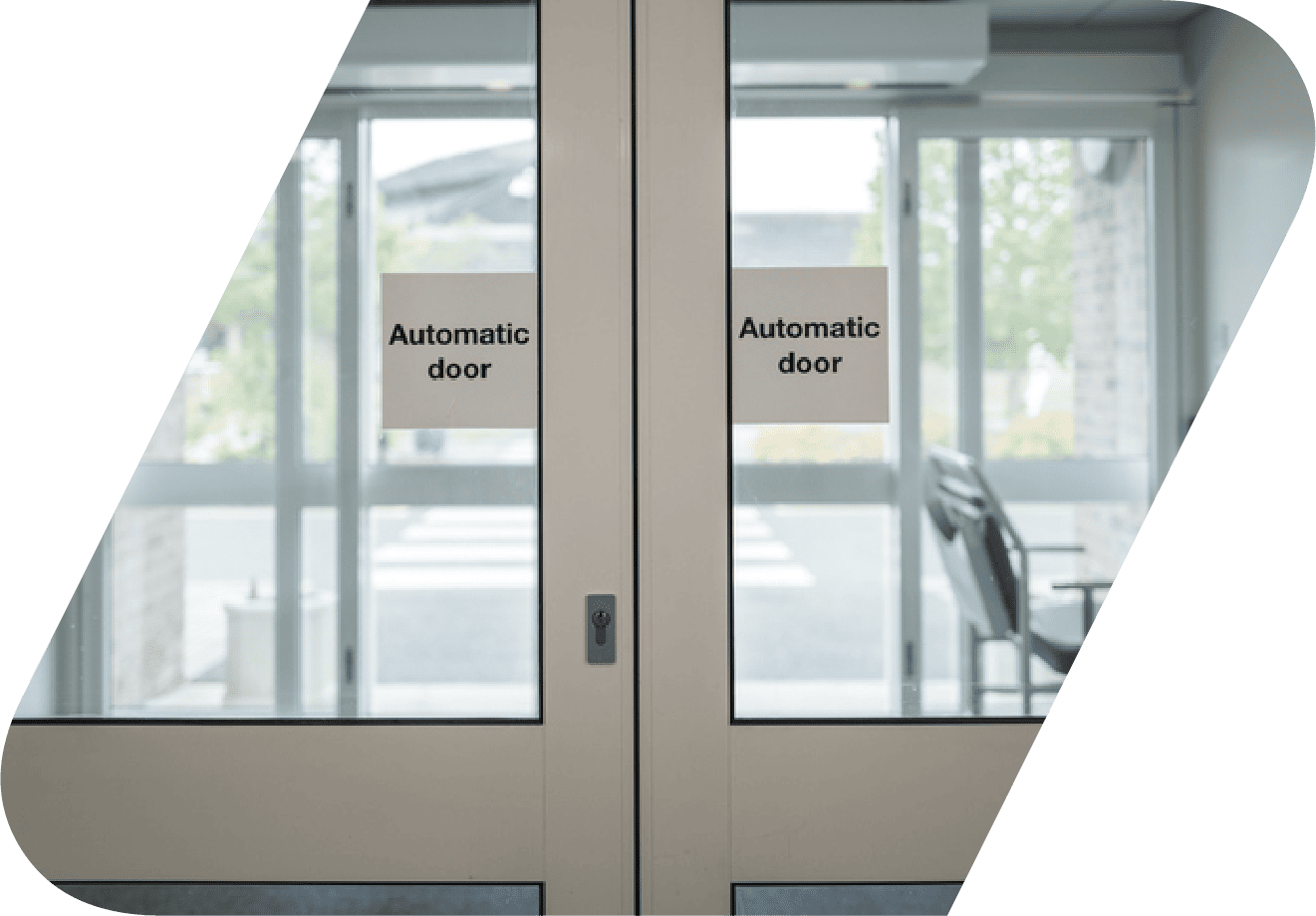

Automatic Doors
Safe, reliable, and fully compliant automated or solutions for high traffic environments that are designed, installed, and maintained by trusted experts.
Our compliant solutions improve accessibility, enhance safety and support the secure, efficient movement of people. Automatic doors are integrated with access control, fire and life safety systems, with national coverage ensuring consistent standards, compliance and reliable ongoing support.

Automatic doors provide safe, convenient access for all users.

Standardised installation and servicing across all locations.

All solutions meet current legislation and ADSA standards.

Controlled opening reduces heat loss and improves building efficiency.

For more information and technical details on
this product, download our product datasheet.
Accredited automatic door experts delivering compliant solutions with nationwide coverage and dependable support.

Delivered in line with recognised automatic door standards.

Sliding, swing and revolving doors tailored to site needs.

Compatible with access control, fire and security systems.

Nationwide servicing ensures reliability and compliance.

BS EN 16005 – 2012
The EN 16005, being a harmonised standard, sets the minimum level of safety allowed within the Machinery Directive for new powered doors, this is a statutory directive to ensure the safety of employees and users. National and European Standards are not legally binding. They are seen as “best practice” and in many cases adopted by organisations as part of rules that must be followed. These safety standards (16005/7036) are always referred to as best practice in courts considering accidents and injuries from use of automatic doors.
Under the Machinery Directive automatic doors must be operated safely, safe for employees and safe for other users. The doors therefore need to be maintained in accordance with the guidance from the manufacturer. However, the law does not specifically state that the doors need to be serviced but failing to maintain them so they are safe in use would lead to a court penalty if there was an injury.
The Directive is issued by the Health and Safety Executive and covers the safety of machinery at work. Full details can be viewed at the HSE website: www.hse.gov.uk/work-equipment-machinery
BS EN 16005 is the European standard which gives guidance on safety in use and test methods for Powered Pedestrian doorsets. It is the industry guidance document to help companies meet the requirements of the Machinery Directive and form part of the CE Marking process. The document gives practical advice on safety systems and best practice ways for ensuring Powered Pedestrian doors are installed with acceptable levels of safety for users. The standard is a minimum level of safety allowed for new installations.
This is more a case of best practice rather than a legal requirement and also protects the service company should litigation or enforcement occur. If a door is not safe to the point that it could seriously harm someone then the engineer should turn the door off and advise the customer to keep it turned off until the safety issues have been resolved. It would be prudent to have this instruction on the engineers signed worksheet as a record. The service company should then provide ASAP a written quotation to the customer of the works needed to make it safe, so they have an option on how to proceed. The customer is relying on the service company to provide best practice advice as to the expert.
We would always recommend that anyone involved in the supply & installation of door automation products has a good knowledge of the regulations and relevant standards including BS EN 16005 & other related standards. The best way of both proving & acquiring the required knowledge is by studying the relevant standards & taking the exam offered by the ADSA. As far as the installation being in a domestic premise it would still fall under BS EN 16005 & related legislation, even though it would be someone’s home for anyone working there such as carers or tradesmen it would be their place of work. We would as always recommend a full “risk assessment” is carried out before any installation in line with the guidelines of BS EN16005 & BS 7036-0 2014.
Answer using BS EN 16005
4.4.2 Materials
There shall be no sharp edges, and glazing shall not form sharp splinters if broken.
Toughened glass in accordance with EN 12150-1 and laminated glass in accordance with EN ISO 12543-1 and EN ISO 12543-2 are examples of suitable glazing materials. Plain float glass (silica-based glass) and wired glass are not suitable for this application due to the risk of serious injury upon breaking.
There is also a risk assessment and reduction standard BS 7036-0:2014, this also states:
7.1 Glazing in power operated door installations should conform to the appropriate part of BS 6262 using safety materials conforming to BS 6206.
7.2 Glazing should be appropriately marked or incorporate features to make its presence apparent.
NOTE Guidance is given in HSE publication L24 [1]
EA-RS is member of The Automatic Door Suppliers Association (ADSA) www.adsa.org.uk and as such adheres to and observes the requirements of EN16005. Investing in the training of its service operatives and its sales team to ensure that all doors exceed the required standards to keep your staff and customers safe when using your doors.
We are also specialists in access control and door entry solutions so we can undertake all aspects of works when adding automation to an entrance, email info@ea-rs.com or phone to 0121 6054499 to discuss your requirements and arrange a free of charge survey.
Combine your automated gate with smart card, fob, or biometric entry systems.
EA-RS offers reliable automated gates for enhanced security and convenience.
Add real-time video feeds to your intruder alarms for immediate visual confirmation.